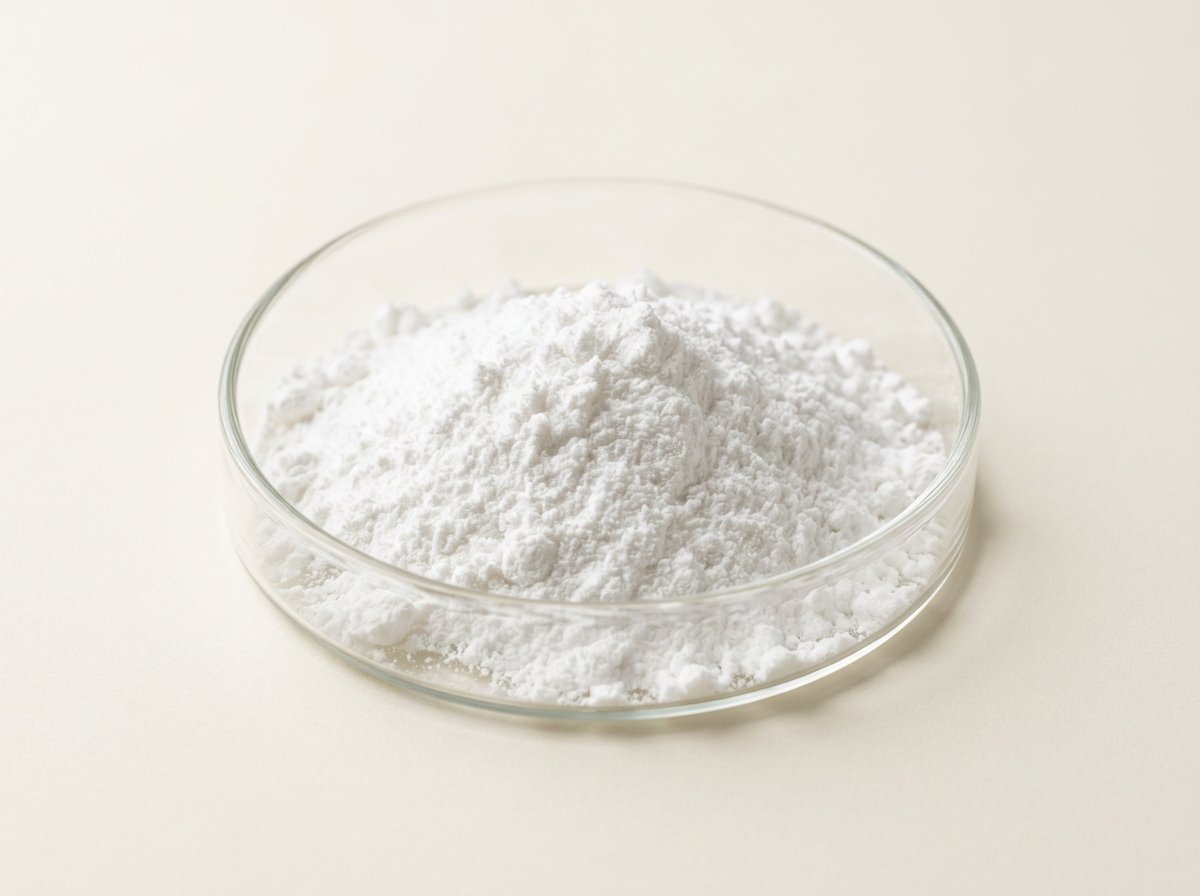
Anyone who has lived through an Indian monsoon or a Gulf summer knows what happens to an open jar of salt: it turns into a solid lump. Food manufacturers fight the same problem at the scale of tonnes. One of the oldest and most trusted tools for keeping powders free-flowing is magnesium carbonate, labelled as E504 in Europe and INS 504 in India.
Why food powders cake
Caking happens when moisture from the air dissolves a thin film on the surface of each crystal or particle. When the air dries again, that film re-crystallises and glues neighbouring particles together. Pressure in stacked bags and temperature swings during transport make it worse. Fine powders, hygroscopic ingredients like salt and sugar, and spice blends with natural oils are all prone to it.
How magnesium carbonate stops it
Light magnesium carbonate is a very fine, porous powder. When a small amount is blended into salt or a spice mix, it:
- Coats each particle with a thin layer that keeps crystals from touching directly.
- Absorbs moisture and oils before they can form bridges between particles.
- Improves flow through shakers, sachet-filling machines and hoppers.
Because it is white, tasteless at normal use levels and chemically mild, it does not change the look or flavour of the food.
Where it is used
| Product | Why magnesium carbonate is added |
|---|---|
| Table and iodised salt | Keeps salt pouring in humid weather |
| Spice blends and masalas | Prevents lumps from natural oils and moisture |
| Powdered drink mixes and sugar | Free flow during packing and in the pack |
| Seasoning sachets for snacks and noodles | Accurate dosing on high-speed filling lines |
| Flour treatment and baking powders | Flow aid and mild acidity regulator |
What the regulations say
India (FSSAI)
Magnesium carbonate (INS 504(i)) is permitted as an anti-caking agent under the Food Safety and Standards (Food Products Standards and Food Additives) Regulations, 2011. The permitted foods and maximum levels are set product by product in the additive schedules, and iodised salt has its own limits for total anti-caking agents. Check the current FSSAI schedule for your exact product category before fixing a dose.
European Union
"Magnesium carbonates" are authorised as E 504 under Regulation (EC) No 1333/2008. E 504 covers both magnesium carbonate and basic magnesium carbonate (magnesium hydroxide carbonate), and purity criteria are set in Regulation (EU) No 231/2012.
United States
Magnesium carbonate is affirmed as Generally Recognized as Safe (GRAS) under 21 CFR 184.1425, for use in food under good manufacturing practice.
Gulf and other markets
Most Gulf Cooperation Council countries and many African markets follow Codex Alimentarius (INS 504(i)), with local labelling rules. Exporters should also check whether the buyer needs halal certification.
Choosing the right food-grade material
- Ask for food grade, not technical grade. Food grade is tested for lead, arsenic and other contaminants to food-additive limits.
- Match the bulk density to your process. Light grade spreads further per kilo and coats better, which is why it is preferred for salt.
- Check fineness. Coarser particles can settle out of a blend and leave visible white specks.
- Start low. Run trials at a low inclusion and increase only as needed, keeping within your market's legal maximum.
- Get the paperwork: batch COA, specification sheet, and where needed halal, kosher or allergen statements.
Frequently asked questions
What is E504 in food?
E504 is the European code for magnesium carbonates, used mainly as an anti-caking agent and acidity regulator in salt, spices and powdered foods.
Is magnesium carbonate in salt safe?
Yes. It is approved by FSSAI in India, by the EU as E504 and as GRAS by the US FDA, and is used at low levels that do not affect taste.
What is the difference between E504(i) and E504(ii)?
Under Codex INS numbering, 504(i) is magnesium carbonate and 504(ii) is magnesium hydroxide carbonate (basic magnesium carbonate). The EU groups both under E 504.
Food-grade supply for India and export
Medovaq makes food-grade light magnesium carbonate at our Gujarat plant. We supply salt refiners and spice packers across India and export to food manufacturers in Saudi Arabia, the UAE, Africa and Europe. Ask for a sample and COA.