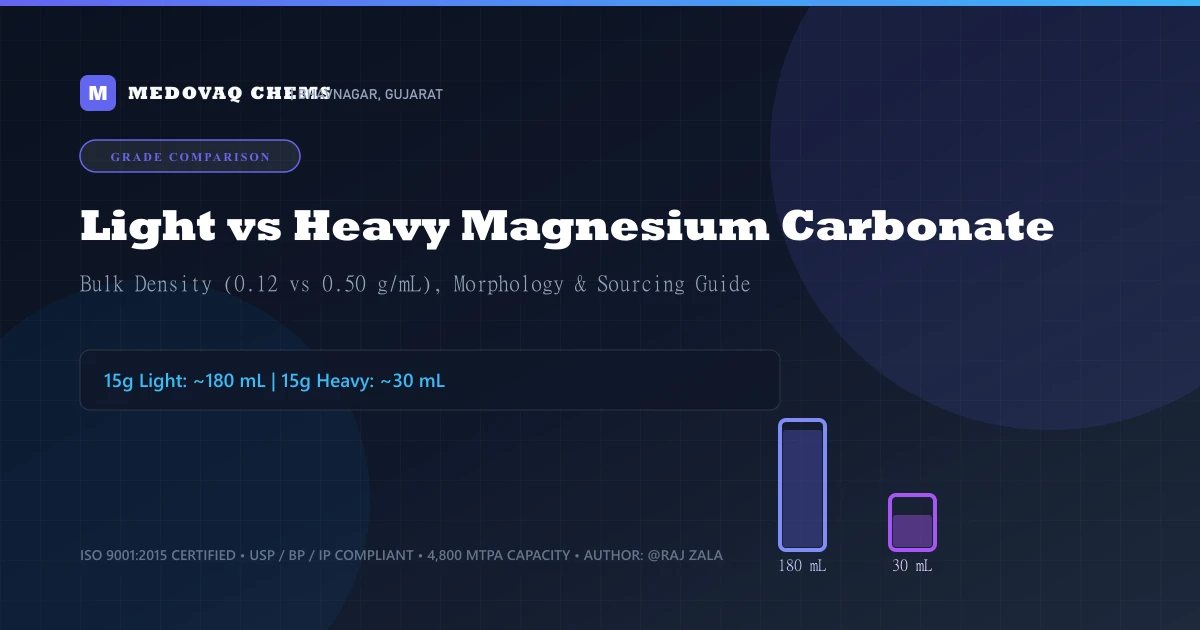
Light and heavy magnesium carbonate share nearly identical chemical formulas and compendial assay standards, yet they behave entirely differently in real-world manufacturing. The distinction is strictly physical: particle microstructure, surface area, and bulk density. Selecting the incorrect grade can disrupt capsule fill weights, skew tablet disintegration profiles, or cause severe dusting and mixing segregation.
This guide provides a comprehensive side-by-side comparison to help formulation scientists, plant managers, and procurement professionals select the exact grade for their manufacturing process.
The short answer
- Light Magnesium Carbonate: Fluffy, voluminous, low-density powder (0.08 – 0.15 g/mL) with high internal porosity and fluid absorbency.
- Heavy Magnesium Carbonate: Dense, compact, free-flowing granular powder (0.40 – 0.60 g/mL) occupying less than one-fifth the physical volume per kilogram.
In standard British Pharmacopoeia (BP) and European Pharmacopoeia (Ph. Eur.) volumetric tests, 15 g of the light grade occupies approximately 180 mL of volume, whereas 15 g of the heavy grade occupies only 30 mL.
Light vs heavy magnesium carbonate: comparison table
| Physical & Commercial Property | Light Magnesium Carbonate | Heavy Magnesium Carbonate |
|---|---|---|
| Poured Bulk Density | Very low (0.08 – 0.15 g/mL) | High (0.40 – 0.60 g/mL) |
| Volume Occupied by 15 g | About 180 mL | About 30 mL |
| Powder Texture | Soft, fluffy, micro-fine, voluminous | Compact, denser micro-granules |
| Particle Microstructure | Needle-like porous agglomerates, high surface area | Prismatic, denser crystalline clusters |
| Liquid & Oil Absorbency | Exceptionally high | Moderate to low |
| Powder Flowability | Good as a glidant, prone to airborne dust | Excellent gravity flow, minimal dust generation |
| Direct Compressibility | Lower compressibility; needs binders or granulation | Superior compressibility in rotary tablet presses |
| Primary Applications | Glidant, carrier for liquid APIs, food anti-caking, cosmetics, sports chalk, rubber | High-dose antacid chewable tablets, hard gelatin capsule filling, dense mineral blends |
Why the density difference matters
Bulk density dictates how much powder mass fits into a finite spatial boundary—whether that boundary is a capsule shell, a rotary tablet press die, an industrial ribbon blender, or a shipping container:
- Solid Oral Dosage Formulations: If your tablet requires a high active magnesium dose within a swallowable tablet size, heavy magnesium carbonate is indispensable. Light grade would require an impractically large tablet die or multi-stage roller compaction.
- Liquid Absorption & Anti-Caking: The expansive internal pore network of light magnesium carbonate enables it to absorb liquid active substances, fragrance oils, or atmospheric moisture, making it the superior anti-caking agent and cosmetic carrier.
- Shipping & Logistics Economics: Because light magnesium carbonate occupies five times the volume of the heavy grade, a 20-foot ocean container carries substantially fewer metric tonnes of light grade, altering freight costs per delivered kilogram.
For detailed testing protocols and purchase order specifications, refer to our comprehensive magnesium carbonate bulk density guide.
How each grade is made
Both varieties are precipitated from aqueous magnesium salts and carbonate solutions. The physical morphology is governed by reaction temperature, concentration, and aging:
- Light Grade Synthesis: Precipitated rapidly at lower temperatures (30°C – 45°C) from dilute solutions. The precipitate is filtered and dried promptly to preserve delicate, needle-shaped porous crystal networks. Learn more in what is light magnesium carbonate.
- Heavy Grade Synthesis: Precipitated at higher temperatures (85°C – 100°C) from concentrated solutions, followed by controlled boiling or digestional aging. This promotes crystal Ostwald ripening, aggregating particles into dense, compact granules.
Which grade should you choose?
Choose Light Magnesium Carbonate if you need:
- Superior oil, sebum, or moisture absorption in cosmetics and dry shampoos.
- Anti-caking flow aids in table salt, spice blends, and powdered beverage mixes.
- A porous excipient carrier to convert liquid or oily actives into free-flowing powders.
- Maximum athletic friction for rock climbing or gymnastics grip chalk.
- Translucent reinforcing fillers for EVA and natural rubber soles.
Choose Heavy Magnesium Carbonate if you need:
- Maximum active magnesium payload in a compact chewable tablet or capsule.
- Direct compression tablet manufacturing with minimal binder additions.
- Dust-controlled manufacturing environments with automated pneumatic conveying.
Pharmacopoeia grades
Both light and heavy magnesium carbonate are documented under distinct monographs in major compendia (USP, BP, Ph. Eur., IP). While their chemical purity criteria (MgO assay between 40.0% and 45.0%, limits on calcium, iron, and heavy metals) are identical, their bulk density monographs differ fundamentally. Formulators must ensure their incoming raw material Certificate of Analysis explicitly references the correct compendial designation.
Frequently asked questions
What is the difference between light and heavy magnesium carbonate?
The primary difference is physical bulk density and particle structure. Light magnesium carbonate has a loose poured density of 0.08 to 0.15 g/mL (15 g occupies ~180 mL), whereas heavy magnesium carbonate has a density of 0.40 to 0.60 g/mL (15 g occupies ~30 mL).
Are light and heavy magnesium carbonate chemically different?
Chemically they are nearly identical hydrated basic magnesium carbonate salts (4MgCO3·Mg(OH)2·nH2O) meeting identical compendial assay limits (40.0% to 45.0% expressed as MgO). Their distinct behaviors stem entirely from physical particle morphology.
Which is better for antacids?
Both are widely used depending on the dosage form. Heavy grade is ideal for compact chewable tablets where die volume is restricted, while light grade is preferred for liquid antacid suspensions because it stays dispersed in aqueous vehicles.
Which grade is used in gym chalk?
Light magnesium carbonate is exclusively used for athletic and climbing gym chalk because its porous micro-platelets maximize sweat absorption and create high friction on the skin.
Get the right grade from Medovaq
Medovaq specializes in manufacturing high-purity light magnesium carbonate alongside customized bulk density grades in Bhavnagar, Gujarat. As an experienced direct magnesium carbonate supplier in India, we assist buyers in matching precise density and mesh parameters to their plant tooling.
Request a sample or speak to our technical team for custom batch tailoring.